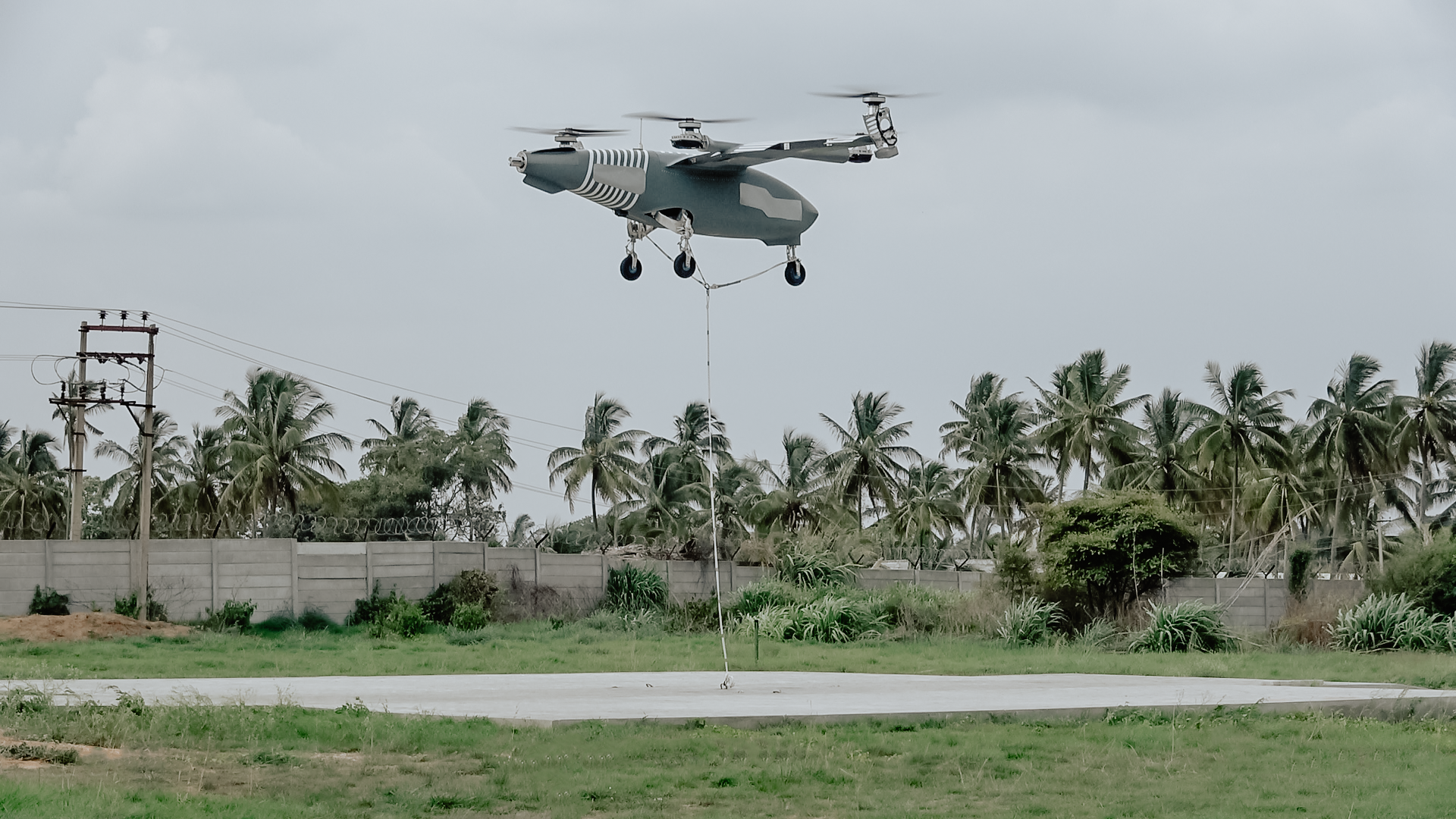
Indian electric aircraft developer Sarla Aviation has completed the flight test campaign for its half-scale eVTOL (electric vertical takeoff and landing) technology demonstrator, Sylla, marking a milestone in the company's development program for its planned Shunya air taxi.
The six-month campaign included more than 500 tests and over 18 hours of flight time field testing. The 700-kilogram-class aircraft has a 7.5-meter wingspan, and is the heaviest electric aircraft to have flown in India, according to Sarla.
The Sylla 1.0 demonstrator was designed to validate the integration of key aircraft systems under real operating conditions rather than serve as a production prototype. During the campaign, engineers evaluated the interaction between the aircraft's electric propulsion system, battery architecture, distributed propulsion, flight-control software, airframe, and landing gear as an integrated platform.
Rakesh Gaonkar, Sarla Aviation's co-founder and chief technology officer, said the program was intended to verify engineering assumptions through real-world testing. He added that the data collected during the campaign is already being applied to the company's next-generation demonstrator.
Sarla also described the program as achieving several national firsts, including the first 700-kilogram-class electric aircraft capable of vertical takeoff to fly in India, the country's first flight of a 400-volt electric powertrain architecture, and the first demonstration of a distributed-propulsion wing system. The company further stated that the project completed full-stack ground testing in accordance with applicable airworthiness regulations. These claims have not been independently verified.
According to the company, Sylla 1.0 completed the engineering objectives for which it was designed, including repeated vertical takeoffs and hover operations under closed-loop flight control. The program has now entered its next phase, with development underway on Sylla 2.0, which is expected to focus on demonstrating controlled transition from vertical flight to wing-borne forward flight.
Commenting on the milestone, Gaonkar said: "Flying Sylla is the moment a thousand simulations become real, validating our aircraft architecture under real flight conditions. We achieved this in under a year, on a fraction of the capital."
Sylla 1.0 progressed from design to flight in under 12 months. The company said total program costs came to less than $13 million, including a full-scale mock-up unveiled at the Bharat Mobility Global Expo in Delhi in 2025 and the subsequent half-scale flying demonstrator.
The company said the pace and capital efficiency of the program contributed to IndiGo Ventures' recent decision to take a stake in Sarla. IndiGo Ventures is listed among the company's existing investors, alongside Accel and Nikhil Kamath.
Roughly 30% of its engineering team previously worked at eVTOL companies including Lilium, Volocopter, and Wisk, according to Sarla.
Founded in 2023 and headquartered in Bengaluru, Sarla Aviation is developing electric aircraft for urban air mobility in India. Its planned production aircraft, Shunya, is designed as a six-passenger-plus-pilot eVTOL intended for urban and regional transportation, with the company targeting entry into service around 2028-2029, subject to certification and further development.